
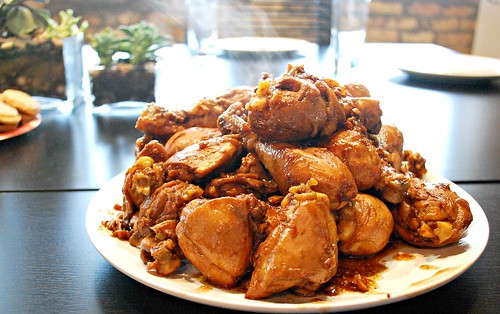
It’s been said that for every Filipino household, there is at least 2 versions of chicken adobo. With so many variations, I’m not surprised that chicken adobo is the national dish of the Philippines. For my Filipino Fiesta, there was no doubt this would be on our menu. The recipe I grew up enjoying and ultimately making isn’t about the ingredients as much as the technique involved. For my Filipino adobo, the chicken is boiled and drained first before using it in preparing adobo. This cooks off any impurities in the chicken, leaving you with a really clean and bright sauce that isn’t muddled. Another technique to note is the step in adding vinegar. It’s important not to stir the simmering chicken once the vinegar is added. The vinegar tightens up the chicken, preparing it to work with the soy sauce and take on that rich brown color.
** Slow Cooker version – Transfer cooked garlic and onion to slow cooker. Add boiled chicken, soy sauce peppercorn, ground black pepper and bay leaves, tossing to coat. Pour vinegar over chicken and do not stir. Cover and cook on HIGH for 2-3 hours or LOW for 4-6 hours.
Introduction
Filipino cuisine is a complex blend of indigenous, Chinese, Spanish, and American influences, each bringing its unique culinary traditions. Among them, Chicken Adobo stands out as a cherished dish, not just in its native Philippines but around the world. The dish has a rich history that dates back to pre-colonial times when the early Filipinos were already stewing their meat with vinegar. The name “adobo” itself is derived from the Spanish word “adobar,” meaning marinade, sauce, or seasoning, which was used by the Spanish colonizers to refer to the indigenous cooking method.
Cultural Significance and Variations
Chicken Adobo carries a significance that goes beyond its taste; it’s a dish deeply embedded in the Filipino way of life. The versatility of Chicken Adobo lies in its simplicity, with its flavor profile being easily adjusted to suit varying tastes and preferences. Regional differences have led to a variety of preparations, including the addition of coconut milk, potatoes, hard-boiled eggs, and various types of vinegar. It’s commonly served with steamed rice or a side of pickled vegetables, known as “atchara.”
Global Appreciation
Chicken Adobo has captured the hearts of food lovers globally, with its presence in Filipino restaurants across various continents. The dish’s straightforward cooking approach and robust flavor profile have contributed to its widespread appeal. It has also found its place in popular media, leading to a deeper interest and respect for Filipino culture and culinary diversity.
FAQs
Q: Is Chicken Adobo considered spicy?
A: Chicken Adobo isn’t typically spicy, focusing on a balance of tangy, salty, and slightly sweet flavors, but can be adapted to include chilies.
Q: How long can Chicken Adobo be stored for?
A: Stored properly in the refrigerator, Chicken Adobo can keep for up to 3-5 days, potentially tasting better as the flavors meld.
Q: Can Chicken Adobo be made vegetarian?
A: Yes, vegetarian variations of Chicken Adobo use tofu or vegetables, maintaining the essence of the adobo flavor.
Q: Why is vinegar an important ingredient in Chicken Adobo?
A: Vinegar acts as a preservative and a crucial flavor component, providing acidity to balance the dish’s flavors and has historical roots in Filipino cooking.

Chicken Adobo
A comforting traditional Filipino dish characterized by its unique combination of soy sauce, vinegar, and spices, bringing a rich flavor to the tender chicken.
- Total Time: 55 minutes
- Yield: 4 servings 1x
Ingredients
2 pounds chicken thighs and drumsticks, bone-in
2 tablespoons vegetable oil
4 cloves garlic, minced
1 onion, minced
1/3 cup soy sauce or tamari
1/2 teaspoon black peppercorn
1/2 teaspoon ground black pepper
2 bay leaves
2/3 cup distilled white vinegar
Instructions
Begin by boiling the chicken thighs and drumsticks to cook off any impurities. This ensures a clean and bright sauce for the Adobo.
Once the chicken is cooked through, remove it from the water and set it aside.
Heat the vegetable oil in a large pot over medium-high heat.
Add the minced garlic to the oil and cook until the garlic is golden brown.
Introduce the minced onion to the pot and cook until the onion has softened.
To the pot, add the boiled chicken pieces.
Pour soy sauce or tamari over the chicken, then season with the black peppercorns and ground black pepper.
Tuck the bay leaves among the chicken pieces.
Gently toss the chicken in the pot to coat it evenly with the seasonings and soy sauce.
Carefully pour the vinegar over the seasoned chicken, taking care not to stir.
Allow the chicken to simmer, uncovered, for 5-7 minutes without stirring to let the vinegar infuse.
After the 5-7 minutes of simmering, stir the chicken in the sauce.
Continue to simmer the chicken uncovered for another 15-20 minutes, or until the sauce has thickened and the chicken adopts a rich, brown coloring.
Serve the Chicken Adobo over a bed of steamed rice for a classic Filipino meal.
Notes
Adjust the amount of soy sauce if a saltier flavor is preferred.
Black peppercorns add a depth of flavor, but can be ground if a smoother sauce is desired.
The key to Adobo is not stirring the vinegar too soon to allow its flavors to develop.
- Prep Time: 15 minutes
- Cook Time: 40 minutes
- Category: Main Course
- Method: Stovetop
- Cuisine: Filipino
- Diet: Halal
Nutrition
- Serving Size: 1 serving
Keywords: Chicken Adobo, Filipino Cuisine, Comfort Food, , , ,













Yum! I will definitely be trying this, thank you for sharing!!
This looks delicious!
Love Adobo! I've never tried to make it myself.
Love this chicken, looks so yummy.